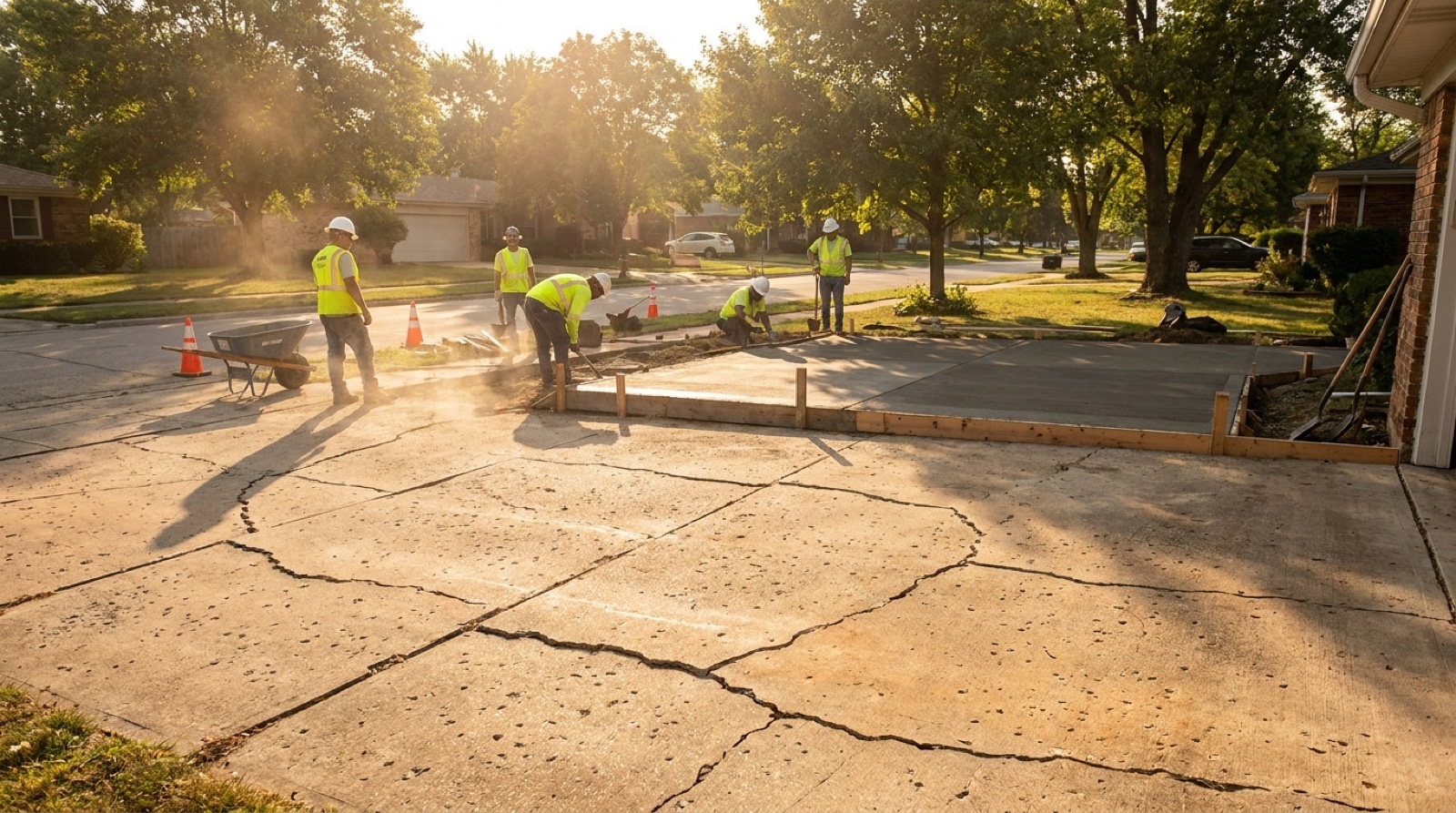
Concrete grows when it gets hot. A slab that measures 40 feet across in February is measurably longer on a 100 degree afternoon, and it has to put that extra length somewhere.
Ohio has already run through one of those stretches this summer. FOX 8 News reported an extreme heat warning with highs near 100 degrees and a heat index around 108 at the start of July. Dayton sits in the same air mass most of the time, and the Miami Valley gets its own version of that heat a day or two later.
Where the Extra Length Goes
A properly built slab has somewhere to expand. That is what control joints, isolation joints and expansion material are for.
When those joints are missing, cut too shallow, or packed solid with dirt and gravel, the slab has no give. It pushes against whatever is next to it until something breaks.
The three failures we see most in July and August
- Joint spalling. Two panels press together and the top edges of the joint chip away. It looks like a ragged trench along a line that used to be clean.
- Blowups. Panels lift and tent at a joint. Rare on residential work but common on long sidewalk runs and older public walks.
- Corner and edge cracking. The slab has room to move in one direction only, so it relieves the stress diagonally at a corner instead.
Why the Damage Shows Up Where Sun Hits Hardest
Heat is not applied evenly to a slab. The top surface bakes in direct sun while the bottom stays cooler against the subgrade.
That temperature difference makes the panel try to curl downward at the edges. Combine curling with the load of a vehicle and you get cracks in driveways that never appear in a shaded patio ten feet away.
South facing and west facing surfaces take the worst of it in Dayton. If you have a driveway that runs uphill toward a west facing garage in Kettering or Centerville, that concrete is absorbing afternoon sun for hours after the air temperature peaks.
What Actually Needs Fixing and What Does Not
Not every summer crack is a problem. Hairline shrinkage cracks that follow a control joint are the slab doing exactly what it was designed to do.
The ones worth attention are the cracks that change elevation, widen past a quarter inch, or run across a panel instead of along a joint.
| What you see | Likely cause | Action |
|---|---|---|
| Hairline crack along a saw cut | Normal joint activation | Monitor only |
| Crack wider than a quarter inch | Movement or subgrade loss | Seal or repair |
| One side sits higher than the other | Settlement or curling | Repair or replace panel |
| Crumbling joint edges | Compression from expansion | Joint rebuild |
| Panel tented at a joint | Blowup | Remove and replace |
A crack that holds a level line across it is usually cosmetic and can wait. A crack with a lip you can catch a shoe on is a trip hazard and, on a public walk, often your legal responsibility as the property owner.
The Cheapest Thing You Can Do This Month
Clean out your joints. That is it.
Over a few years, expansion joints fill with mulch, sand, pea gravel and weed roots. Once the joint is packed solid it stops being a joint and becomes a hard stop.
Rake the debris out with a screwdriver or a joint knife, blow the channel clear, and put fresh sealant or backer material in. On driveway slabs and backyard patio areas this takes an afternoon and buys you room to move for the next heat wave.
The other summer job worth doing
Check where your slab meets brick, stone or the house foundation. Those materials expand at different rates, and a hard connection between them is where summer stress concentrates.
If a patio is butted tight against a foundation wall with no isolation material, that is a problem for the wall, not just the patio. Anything pushing on a foundation deserves a real look before winter.
When Repair Stops Making Sense
Concrete repair is worth it when the slab is structurally intact and the damage is local. Patch the panel, seal the joint, move on.
It stops making sense when the base under the slab has failed. If you have multiple panels moving independently, or water is undermining the subgrade every time it rains, patching the surface just hides the problem for a season.
At that point taking the old slab out and rebuilding the base is cheaper over five years than three rounds of repair. That is a judgment call and it depends on what is under the concrete, not what is on top of it.
Heat Sets the Timeline for Everything Else
Summer damage does not stay a summer problem. Every crack that opens in July fills with water in October and freezes in January.
Dayton runs through dozens of freeze and thaw cycles each winter. Water in a crack expands about nine percent when it freezes, and it works that crack wider every single cycle.
That is why we push people to handle cracks and joint damage in late summer rather than waiting. The same repair costs the same money in September and prevents a winter's worth of damage that it cannot prevent in March.
Uneven walkway sections follow the same rule. A quarter inch lip in July is a full inch lip after one winter of water getting underneath it.
Get Someone to Look at It
Most of what we find on a summer walkthrough in Beavercreek or Huber Heights is minor. Joints need clearing, a couple of cracks need sealing, and the slab has another decade in it.
The point of looking is to find the one thing that is not minor before it turns into a replacement. If you have a slab that changed this summer, get in touch and we will come take a look and tell you honestly whether it needs anything at all.