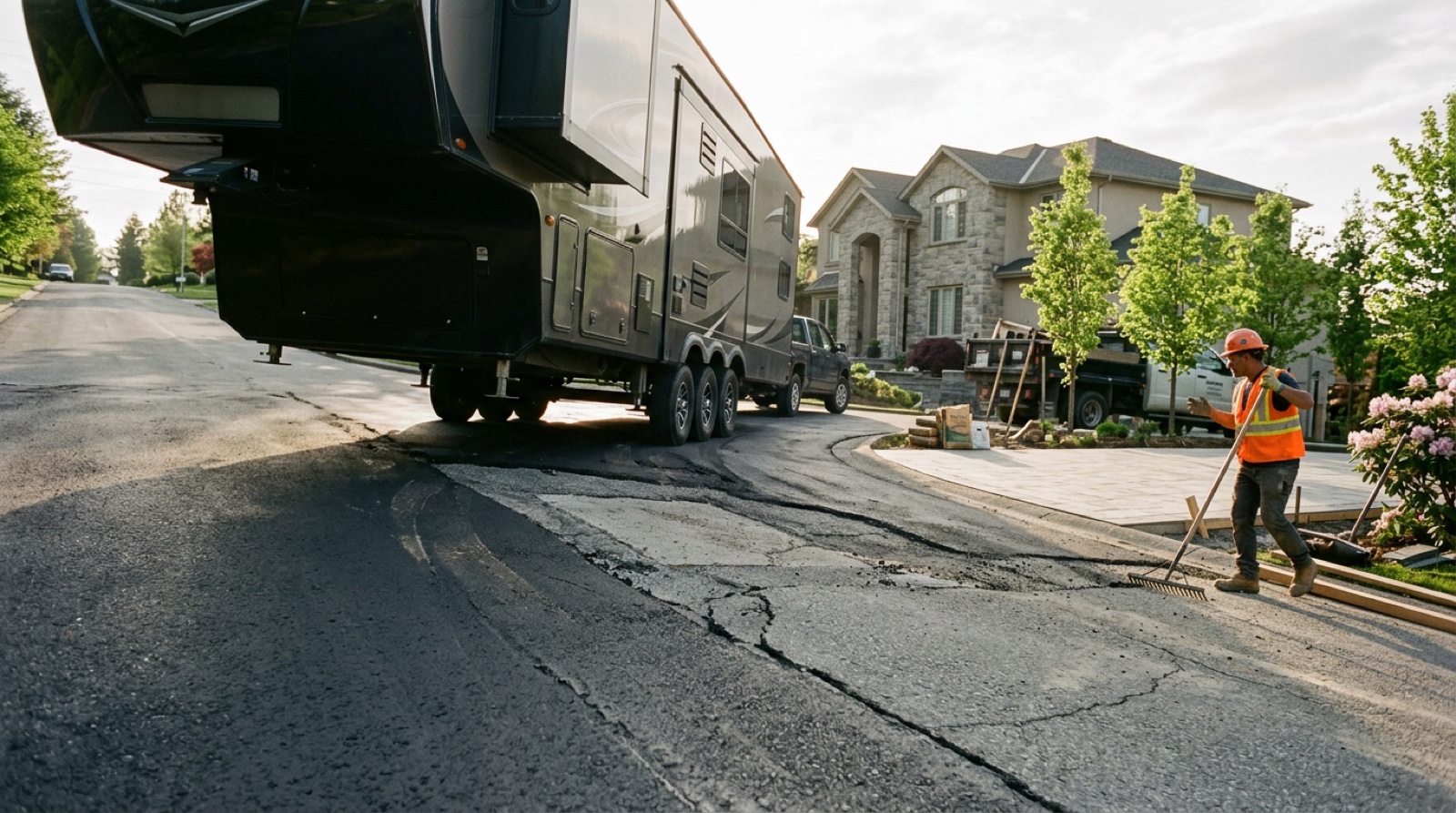
If you are hitching up a camper for a park trip this summer, the weakest link is probably sitting in front of your house right now.
A typical residential driveway in Dayton is poured around four inches thick over compacted stone. That thickness is sized for cars and light trucks, not for a loaded travel trailer sitting in one spot for three weeks.
Stacker recently ranked the closest national parks to Dayton, and the two nearest are Cuyahoga Valley at roughly 168 miles and Indiana Dunes at roughly 198 miles. Both are realistic weekend runs, which is why trailer and RV traffic picks up around the Miami Valley every July and August.
The Problem Is Concentrated Load, Not Total Weight
Concrete handles broad, spread out weight very well. It handles point loads much worse.
Your car spreads its weight across four wide tires and moves off the slab every day. A parked trailer puts a large share of its weight on two axles in a fixed spot, plus a tongue jack or stabilizer pads pressing down through a footprint the size of a coffee mug.
That jack foot is where most driveway damage starts. A few thousand pounds through three or four square inches of contact will punch, spall, or crack a residential slab.
Typical Loaded Weights
Use these ranges as a rough sanity check only. Your actual number is on the GVWR sticker near the trailer door or on the driver side frame.
| Type | Typical loaded weight | Driveway risk |
|---|---|---|
| Teardrop or small utility trailer | 1,000 to 2,000 lb | Low |
| Pop up camper | 2,000 to 3,000 lb | Low to moderate |
| Travel trailer | 5,000 to 9,000 lb | Moderate to high |
| Fifth wheel | 12,000 to 18,000 lb | High |
| Class A motorhome | 20,000 lb and up | High |
Where Dayton Driveways Give Out First
The Edges
Slab edges have no confinement on the outside. When a trailer tire rolls off the pavement or parks with one wheel hanging past the edge, the concrete snaps off in a long strip.
This is the single most common camper related failure we see, and it almost always shows up as a crack running parallel to the edge before the piece actually breaks free.
The Apron at the Street
The section between the sidewalk and the street takes every turning load from a long trailer. Backing a fifth wheel in at an angle grinds and twists that panel repeatedly.
If your apron already has a spiderweb of cracking, more trailer traffic will finish it. That panel often needs targeted repair before it turns into a full replacement.
The Ground Underneath
Southwest Ohio soils hold a lot of clay, and clay moves with moisture. A dry stretch shrinks it, then a heavy Miami Valley storm swells it back.
A slab bridging a soft spot has no support under it. Add a parked camper and you get a cracked panel that starts to rock underfoot.
Cheap Things To Do Before You Leave
- Put a wide pad under every jack and stabilizer. A scrap of pressure treated lumber or a proper leveling block spreads the load across a much larger area.
- Do not park a loaded trailer within about a foot of any slab edge.
- Move the trailer a few feet every couple of weeks rather than leaving it on the same patch all summer.
- Keep water off the subgrade. Downspouts dumping alongside the driveway soften exactly the soil that has to carry the load.
- Look for new cracks after the first heavy park. Fresh cracking under load is a warning, not a cosmetic issue.
Repair, Replace, or Build For It
Not every crack means a new driveway. Hairline shrinkage cracks in an otherwise flat slab are normal and can usually be sealed.
The signals that point toward replacement are different. Panels that rock, cracks with a vertical lip between the two sides, and crumbling that goes deeper than the surface all mean the slab or the base under it has failed.
When a driveway reaches that point, the honest answer is that patching it wastes money. The old slab comes out, the base gets rebuilt and compacted properly, and the new pour gets designed around the weight it will actually carry. Homeowners who tow regularly often go thicker with a reinforced parking pad off to one side, which keeps the heavy load off the main driveway surface entirely.
That kind of job usually starts with taking out the failed slab and hauling it off, then rebuilding from the subgrade up. It is more work than a patch, and it lasts decades instead of a season.
Late Summer Is a Good Window in Dayton
August and September give you warm days, cooler nights, and enough runway before the first freeze for a new pour to gain strength. That beats trying to squeeze work in during a wet March.
If you are already scheduling exterior projects for the back half of the year, this is also the natural time to handle a settled walkway or front path or the patio you have been putting off, since the crew and the equipment are on site anyway.
We work throughout Dayton, Kettering, Beavercreek, Huber Heights, Centerville, and the rest of the Miami Valley. Send us a few photos and we will tell you whether it needs a repair or a rebuild, or call (937) 939-2611 and we will come look at it.