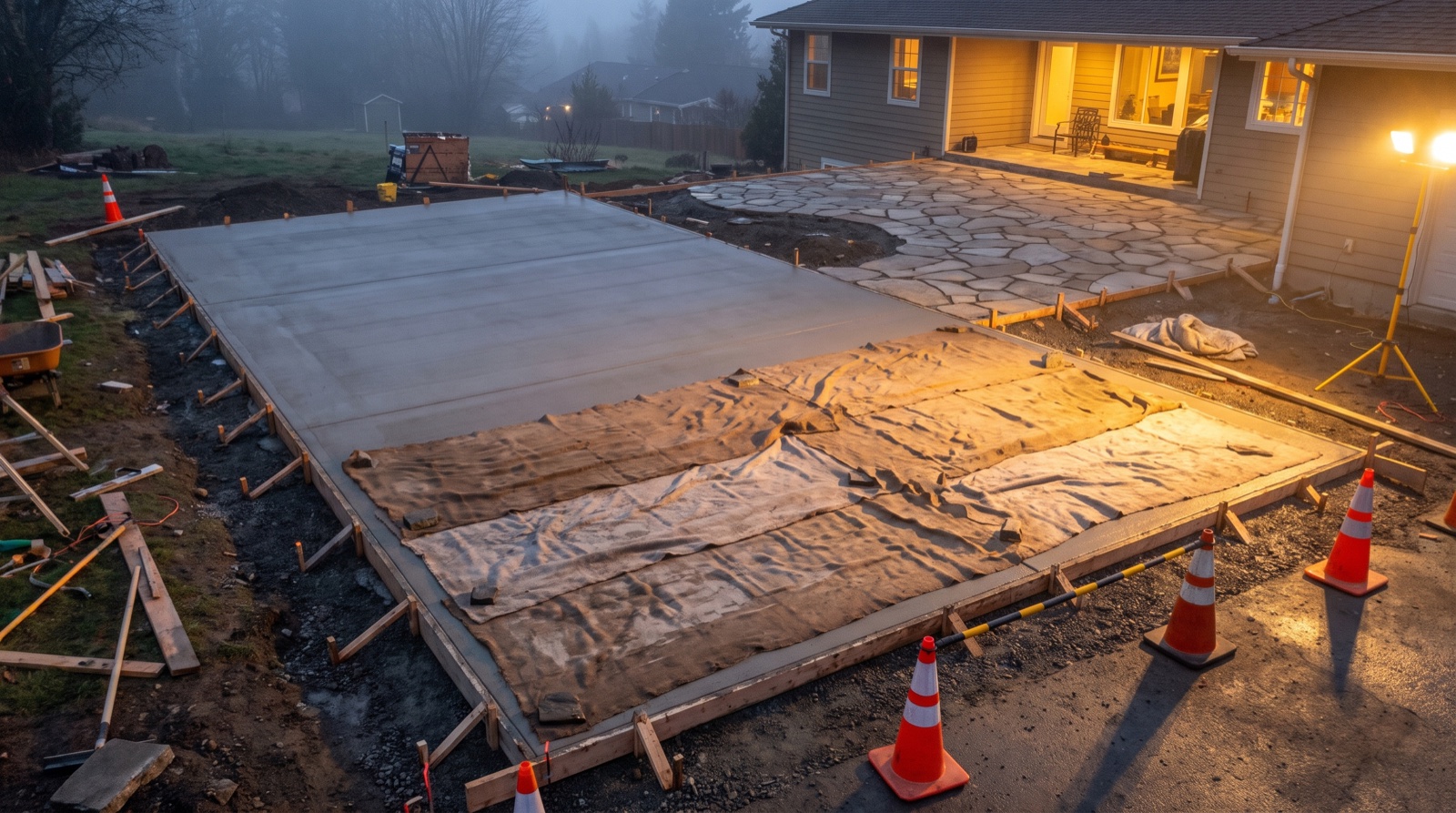
New concrete can take foot traffic in 24 to 48 hours, passenger cars after about 7 days, and it reaches full design strength at around 28 days. Those three numbers cover most of what a homeowner needs to plan around.
Weather can stretch every one of those windows. A cool fall week in Dayton is a good example, because cold nights slow the whole process down.
Drying and Curing Are Not the Same Thing
Concrete does not get hard by drying out. It hardens through hydration, a chemical reaction between cement and water that keeps going for weeks.
Dry describes the surface, which can look and feel finished within a day. Cured describes strength, and that takes much longer to build.
This is why a slab that looks ready often is not. It is also why concrete that loses its moisture too fast ends up weaker and more likely to crack.
The Concrete Curing Timeline
| Time After Pour | What It Can Handle | Approximate Strength |
|---|---|---|
| 24 to 48 hours | Light foot traffic | Low |
| 3 days | Normal foot traffic | Around 40% |
| 7 days | Cars and light trucks | Around 70% |
| 28 days | Heavy vehicles, sealing | Full design strength |
These figures assume a standard residential mix and mild weather. Your contractor may adjust them based on the mix and the conditions on pour day.
24 to 48 Hours: Walking
After a day or two, the surface is firm enough to walk on without leaving marks. Keep pets, bikes, and anything with wheels or sharp feet off it for a little longer.
This is the point where a new sidewalk or front walk becomes usable again. Patios can take foot traffic at the same stage, but hold off on heavy furniture and grills for about a week.
7 Days: Driving
At one week, concrete has reached roughly 70 percent of its final strength. That is enough for a normal car, SUV, or pickup on a properly poured driveway.
Stay off the edges for a while longer, since they have the least support. Avoid turning the steering wheel while the vehicle is stopped, because that can scuff a young surface.
28 Days: Full Cure
Twenty eight days is the industry standard for concrete to reach its specified strength. After that point it can handle moving trucks, loaded trailers, RVs, and roll off dumpsters.
Concrete keeps gaining a small amount of strength after 28 days. For practical purposes, though, this is the finish line.
How Temperature Changes the Timeline
Concrete cures best when the air is between about 50 and 80 degrees. Outside that range, the schedule shifts.
- Below 50 degrees: Hydration slows down, so each milestone can take several extra days.
- Below 40 degrees: Curing nearly stalls, and the slab needs insulated blankets or other protection.
- Freezing in the first day or two: Water in the mix can freeze and expand, which permanently weakens the surface.
- Above 85 to 90 degrees: Surface water evaporates too quickly, which leads to shrinkage cracks and a weaker top layer.
Ohio weather covers that entire range in a single year. A July pour in the Miami Valley needs an early start and moisture control, while a late October pour often needs blankets overnight.
Humidity, wind, and direct sun matter too. A breezy, sunny afternoon can pull moisture out of a slab faster than a hot but still one.
What Not to Do While Concrete Cures
Most early damage comes from using the slab too soon or treating it like finished concrete. Avoid these mistakes during the first month.
- Do not drive on it before day 7. Add a few days if nights have been dropping into the 40s.
- Do not park heavy vehicles on it for 28 days. Ask delivery drivers and movers to stay on the street.
- Do not let it dry out in the first week. Follow the curing instructions you were given, whether that means misting, covering, or leaving a curing compound alone.
- Do not seal it early. Most sealers need the concrete to cure for about 28 days first.
- Do not use deicing salt the first winter. Use sand for traction instead, since salt adds to freeze and thaw damage on young concrete.
- Do not drag heavy objects across it. Lift furniture, planters, and equipment into place.
Skipping these steps is a common reason slabs scale, flake, or crack years ahead of schedule. Once that damage sets in, the fix is usually patching or resurfacing instead of a simple touch up.
Does the Type of Project Matter?
The chemistry is the same for every slab, but the usable date depends on the load. A patio or walkway only has to carry people, so it is back in service much sooner than a driveway.
Decorative work has extra steps. Stamped and colored concrete follows the same cure schedule, but it also needs washing and sealing before it is truly finished.
Thickness and mix design play a part as well. Some mixes include accelerators for cold weather or retarders for hot weather, and your contractor should tell you if either one changes your timeline.
The Short Version
Walk on it after 24 to 48 hours, drive on it after 7 days, and treat it as fully cured at 28 days. Add time when it is cold, and protect the surface from drying out when it is hot.
If you are planning a pour in Dayton, Kettering, Beavercreek, or anywhere nearby, we can give you a realistic schedule for your project and the season. Get in touch for a free quote or call (937) 939-2611.