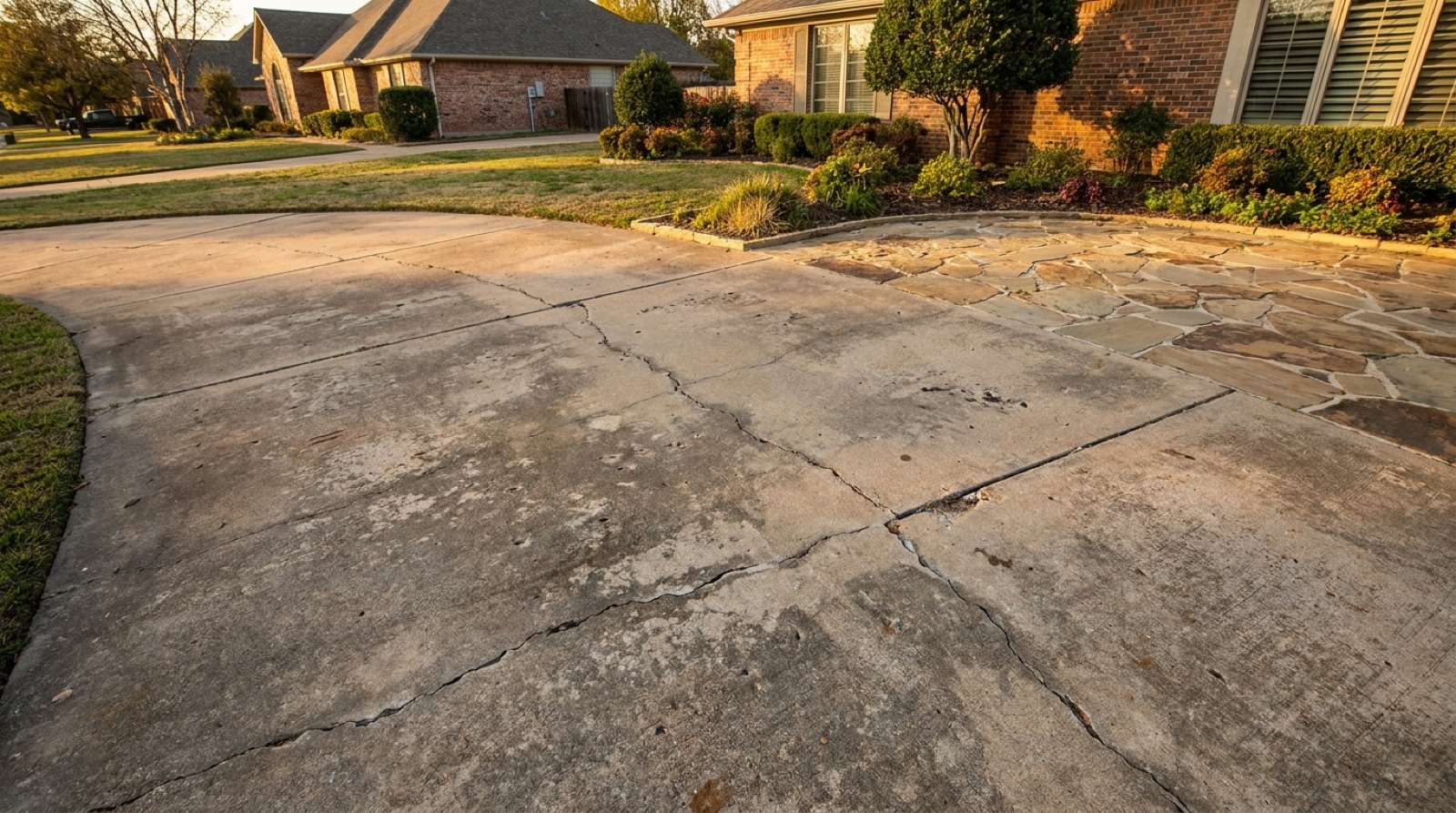
A Properly Built Concrete Driveway Lasts 30 to 50 Years
That is the realistic range for a residential slab poured at four inches over a compacted stone base. Plenty of driveways in older Dayton neighborhoods have passed the 60 year mark and still carry daily traffic without complaint.
Badly built slabs fail far sooner. A driveway poured over soft fill, cut with the wrong joint spacing, or finished in the wrong weather can crack across its full width inside five years.
So the honest answer is that lifespan is decided by two things. How it was built, and what you do to it after the first winter.
What Actually Sets the Number
The base underneath
Concrete rarely fails because the concrete itself was weak. It fails because the ground under it moved.
Four to six inches of compacted gravel spreads the load evenly and gives water a path away from the slab. Miami Valley soils carry a lot of clay, which swells when wet and shrinks when dry, so skipping compaction is the most common reason a local driveway cracks early.
Thickness and reinforcement
Four inches is enough for cars and half ton pickups. Five to six inches with rebar or wire mesh is what you want if a work truck, an RV, or a loaded trailer parks there regularly.
The upgrade adds maybe fifteen percent to the cost of a new driveway pour and can add a decade or more to the service life.
The mix and the weather on pour day
Ohio driveways should use a 4,000 psi mix with entrained air. Those microscopic air pockets give freezing water somewhere to expand, which is the difference between a surface that lasts and one that flakes apart.
Timing matters just as much. Concrete placed in July heat without proper curing, or in late November when night temperatures drop, never reaches its full strength.
How the Dayton Climate Shortens the Clock
Southwest Ohio gives concrete a hard time. We routinely swing above and below freezing dozens of times between December and March.
Every one of those swings pulls water into the surface pores and then expands it. That is what causes scaling, the shallow flaking that makes a driveway look chewed up long before it loses structural strength.
Road salt makes it worse. Salt tracked off Dayton streets increases the number of freeze cycles the surface goes through and attacks unsealed concrete directly.
Two rules cover most of the damage. Never use deicers on concrete in its first winter, and choose calcium chloride or sand over the ammonium based products sold as fast acting ice melt.
Sealing: How Often and What Kind
Sealing is the cheapest thing you can do to extend the life of a slab. A penetrating silane or siloxane sealer soaks in and blocks water and salt rather than sitting on top as a film.
Seal a new driveway about 30 days after the pour, then every three to five years after that. Heavier traffic and full sun exposure push you toward three.
Skip the glossy acrylic film sealers on a driveway. They look sharp for one season, then peel, and they turn slick when wet.
An easy field test: pour a cup of water on the surface. If it beads, the sealer is working. If it darkens the concrete and soaks in, you are due.
Joints Are the Part Everyone Forgets
Control joints are the grooves cut into the slab, usually every 10 to 12 feet. They exist so the concrete cracks where you chose rather than randomly across the middle.
Those joints need to stay filled. Open joints collect water, grit, and salt, all of which work down to the base and undermine the slab from below.
Clean them out and refill with a self leveling polyurethane caulk every few years. The same goes for the expansion joint where the driveway meets the garage or a connecting walkway.
A Realistic Maintenance Schedule
| Task | How Often | Why It Matters |
|---|---|---|
| Reseal surface | Every 3 to 5 years | Blocks water and salt intrusion |
| Refill control joints | Every 3 to 5 years | Keeps water out of the base |
| Clear edge drainage | Twice a year | Prevents soil washout and edge cracking |
| Fix small cracks | As they appear | Stops freeze damage from widening them |
| Clean off oil and rust | As needed | Protects the sealer and the surface |
Signs You Are Near the End
Hairline cracks and light surface wear are normal on a twenty year old slab and worth fixing. Structural failure looks different.
- Sections that have sunk or heaved more than an inch out of plane
- Wide cracks with crumbling edges that run the full width of the drive
- Deep scaling that exposes the aggregate across large areas
- Rocking slabs that move when a vehicle drives over them
Isolated problems usually respond well to targeted repair and slab leveling. Once more than about a third of the surface has failed, removing the old slab and starting over costs less than chasing repairs year after year.
Getting a Straight Assessment
Most driveways we look at across Kettering, Beavercreek, and Centerville have more life left than the homeowner assumed. The ones that do not usually show base failure, which no amount of surface work fixes.
If you are unsure which category yours falls into, get in touch for an honest look at it. We will tell you if sealing and joint work buys you another fifteen years.