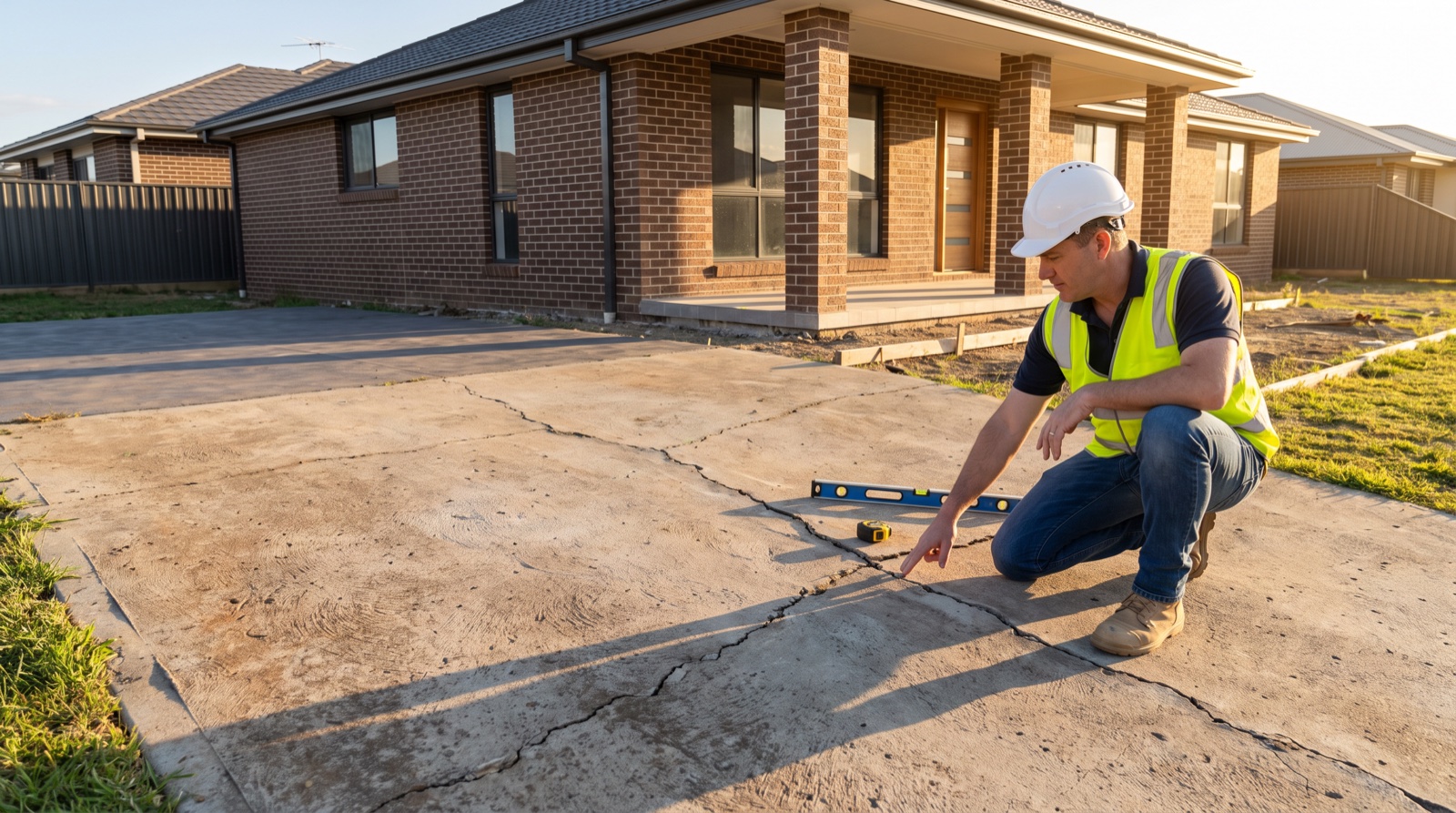
Spend ten minutes on the flatwork before you write an offer. Driveways, porches, walks and patios are among the most expensive items on a property, and a standard home inspection often covers all of them in one or two lines.
Livability recently published a guide to finding the right neighborhood across the Dayton region, covering everything from downtown living to southern suburbs like Springboro. Once you have narrowed the search and you are standing in an actual driveway, here is what to look at.
Start at the Driveway
Walk the full length of the slab and pay attention to the two ends. The garage apron and the street edge take the most abuse from turning tires, plow blades and standing water.
Check whether neighboring panels have settled against each other. If you can catch the toe of your shoe on a lip between two slabs, the gravel base underneath has moved, and that is a base problem rather than a surface problem.
Pitting and exposed pebbles across the surface usually mean years of de icing salt on concrete that was never sealed. It reads as cosmetic at first, then turns structural once water works into the weakened top layer and freezes.
None of this automatically kills a deal. It does change the math, because sealing a sound slab and pouring a replacement driveway are not remotely the same expense.
Reading the Cracks
Every slab in Ohio cracks eventually. What matters is which kind of crack you are looking at.
| What you see | Likely cause | What it usually means |
|---|---|---|
| Fine random lines across the surface | Shrinkage while the slab cured | Cosmetic. Seal it and keep an eye on it. |
| A straight split along a tooled joint | The slab doing exactly what the joint was cut for | Normal. Keep the joint filled. |
| A wide crack with one side sitting higher | Base settlement or a washout under the slab | Get it priced. Often a panel replacement. |
| Cracking near a downspout or low spot | Water pooling under or against the concrete | Fix the drainage first, then the concrete. |
| Crumbling edges and widespread flaking | Freeze thaw damage plus salt exposure | The surface has reached the end of its life. |
Take photos of anything in the bottom three rows. Those are the ones worth getting a real number on before your inspection window closes.
Porches, Steps and the Front Walk
Concrete steps that have pulled away from the house are common on older Dayton and Kettering homes. The gap tells you the stoop settled independently of the foundation, which is normal but still needs attention before it becomes a trip hazard.
Walk the front approach slowly and look for uneven joints between panels. A sunken section of sidewalk or walkway is both a liability and a sign that water is moving under the concrete.
Check the handrail anchors too. Rusted anchors that have spalled the surrounding concrete usually mean the whole step needs rebuilding rather than patching.
The Backyard Slab
Set a level or your phone on the patio and check the fall. A slab should shed water away from the house, and one that pitches back toward the foundation will keep causing problems no matter what you do to the basement.
Look at how the patio meets the house wall. A clean expansion joint is what you want. Concrete poured hard against siding or brick with no joint is a future crack you have not met yet.
Grade, Water and the Foundation
Follow every downspout to where it discharges. Anything dumping within a few feet of the wall is feeding water straight into the soil that supports your slabs and your footings.
Inside, look at the basement or crawlspace walls on the same side of the house as the worst exterior settlement. Problems above ground and problems at the foundation often share one cause, which is water that never had anywhere to go.
Older Streets Versus Newer Ones
Established neighborhoods
In Oakwood, older parts of Kettering and the original sections of Centerville, you are frequently looking at original driveways that have been through decades of Ohio winters. Assume the concrete is near the end of its service life unless it clearly is not.
Newer developments
In Beavercreek, Huber Heights and the newer Springboro builds, the concrete is younger but the backfill around the house is too. Watch for settlement in the strip closest to the foundation, where disturbed soil has had less time to compact.
Turn What You Found Into a Number
Sellers negotiate against written quotes, not against opinions. Get a contractor out during the inspection period so you have a document rather than a guess.
Ask three questions when you do. Is this a repair or a replacement, does drainage need to be corrected first, and how long will the work take once the weather cooperates.
Plenty of what buyers find falls under straightforward concrete repair rather than a full tear out, and knowing which side of that line you are on before closing is worth the phone call. If you are under contract on a home anywhere in the Miami Valley, reach out for a quote or call us at (937) 939-2611 and we will walk the property with you.